


How to Fix iPhone Says It's Charging But Isn't

"I found that my iPhone can't charge successfully today. I plugged it into the charger and then went away, but the battery percentage is still 10% after 2 hours. Do you have any suggestions? Any responses would be greatly appreciated."

Have you ever plugged in your iPhone, seen the charging icon, and returned later only to find the battery completely dead? You left it indicating that it was charging, but clearly, no charge was flowing in. If you are now facing iPhone says it's charging but isn't issue, you're not alone. We will walk you through the 11 reliable ways to resolve this fake charging glitch.
- Why Is My iPhone Not Charging Even Though It Says It Is?
- [Video Tutorial] Fix iPhone Showing Charging But Battery Percentage Not Increasing
- Basic Hardware & Connection Checks [3 Methods]
- iOS Usage & Battery Optimization [3 Methods]
- System and Software Repairs [4 Methods]
- Hardware Damage and Professional Help [1 Method]
- FAQs About iPhone Battery Percentage
- Conclusion
Why Is My iPhone Not Charging Even Though It Says It Is?
If there is an issue with your hardware, software, or system, you will likely encounter this frustrating scenario. Understanding the root cause is the first step toward a permanent fix.
- Degraded Hardware: The battery's maximum capacity might have fallen below standard operating levels, or physical debris might be blocking the port. If the cable is damaged or not properly certified, the iPhone might still recognize it but won’t receive consistent power.
- Software Incompatibilities: If you have installed an unofficial application with uncertain glitches, or updating to a buggy iOS version, it can also disrupt the charging communication.
- Software Bugs or iOS Glitches: Occasionally, software issues in iOS may interfere with charging behavior. A system bug can cause the charging icon to appear even when the device isn’t actually receiving power.
[Video Tutorial] Fix iPhone Showing Charging But Battery Percentage Not Increasing
Now, you can watch the following video and learn some effective solutions to fix the iPhone charging issue quickly.
Basic Hardware & Connection Checks [3 Methods]
When your iPhone displays the charging icon but the battery refuses to climb, physical connection issues are the most frequent culprits. A frayed cable, a weak power outlet, or a charging port packed with pocket lint can easily trigger this frustrating communication error.
Method 1: Examine Power Source
Verify that your device is genuinely receiving an electrical current from the outlet. You should see a green battery icon featuring a lightning bolt in your status bar. If this indicator is missing, double-check that your wall adapter is securely plugged into a functional, switched-on power socket.
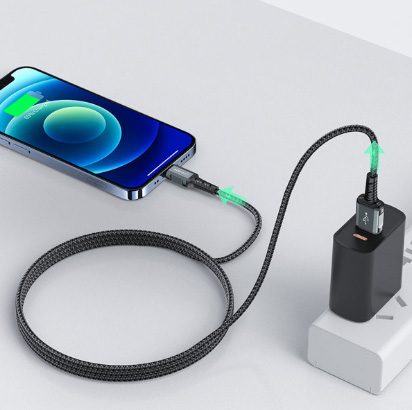
Method 2: Clean Out the Charging Port
Sometimes, the charging port could contain debris and junk that makes it not responsive. Look for a flashlight to observe the charging port if you might see some junk.
- Step 1. Take a clean, anti-static brush or a wooden toothpick.
- Step 2. Carefully sweep back and forth inside the port to loosen the buildup.
- Step 3. Plug the cable back in to test if the power flows normally.

Method 3: Charge with Another Lighting Cable
Your current cable might be internally damaged even if it looks perfectly fine on the outside. Using uncertified accessories can also prevent adequate power transfer and even damage your device over time. Try swapping out your cord for an official, MFi-certified Apple cable to see if the battery percentage finally begins to rise.

iOS Usage & Battery Optimization [3 Methods]
Sometimes the physical charger is working perfectly, but your device is simply consuming power faster than it can absorb it. If you are running heavy applications or utilizing resource-intensive features while plugged in, the battery percentage will inevitably stagnate or drop.
Method 4: Close Background Apps to Improve Charging Speed
If you have many apps running in the background, it can slow down your iPhone's charging speed and cause the battery percentage to stagnate. Here's how to close background apps on your iPhone:
- Step 1. Swipe up from the bottom of your screen and pause to open the app switcher.
- Step 2. Swipe left or right to view all active background apps.
- Step 3. Swipe up on each individual app preview to force them to close.
After closing all background apps, plug your iPhone in and check if it is charging properly.

Method 5: Don't Use Your iPhone While Charging
Using your iPhone for activities like using the camera or playing games while it's charging can draw more energy, reducing the amount of charge that goes into the battery. Although it might be tempting to use your phone while it charges, doing so will slow down the increase in battery percentage. To ensure your device charges quickly without any interruptions, leave it on charge for at least an hour and then check the battery level.
Method 6: Turn On Low Power Mode
Turning on Low Power Mode on your iPhone can help it charge more quickly and efficiently. This mode reduces power consumption by limiting background activities like app refresh. To enable Low Power Mode, you can follow the quick steps:
- Step 1. Open the Settings app on your iOS device.
- Step 2. Scroll down and tap on the Battery option.
- Step 3. Toggle the Low Power Mode switch to the active position.

System and Software Repairs [4 Methods]
If your cables are pristine and your power habits are in check, a deeper iOS glitch is likely to blame. Software bugs can easily freeze the battery display interface or disrupt the underlying firmware responsible for managing power intake.
Method 7: Hard Reset Your iPhone
There is a possibility that while you were using your phone, it crashed, and thus, it is having trouble charging. A hard reset will force the iPhone to restart quickly and fix iPhone shows charging but not charging. There are various methods to restart it depending on the model you are using.
- For newer models like the iPhone 8 and above, quickly press and release Volume Up, then Volume Down, and finally hold the Side button until the Apple logo appears.
- For iPhone 7 series, press and hold the Volume Down and Power buttons simultaneously until the Apple logo appears, then release them, as the device will be restarting.
- For iPhone 6 or earlier models, keep holding both the Home and Power buttons until the Apple logo appears.

Method 8: Update iOS System Version
Running outdated software often leads to unexpected performance bugs and interface freezes. Updating the iOS system version is also an effective solution to fix the system issues. You can follow the below steps to update it now.
- Step 1. Open Settings app on your iPhone and tap on the General option.
- Step 2. Select the Software Update option to scan for new system versions.
- Step 3. Tap the Update Now option to install the latest Apple firmware.

Method 9: Fix iPhone Problems with TunesKit iOS System Recovery
If the methods mentioned above have failed to solve the problem, you will need a third-party software to help you solve it. Professional tools like the TunesKit iOS System Recovery have been rated as the best when it comes to solving the iOS system problems of the iPhone.
TunesKit iOS System Recovery can not only help you deal with iPhone charging problem, but also over 150 iOS-related issues can be fixed using it, such as being stuck in the recovery mode, DFU mode iOS update failure, ect. The latest iOS 26 and iPhone 17 models are supported. It's a piece of cake to fix your iOS system with its intuitive interface and simple steps.
Key Features of TunesKit iOS System Recovery
Fix more than 150 iOS issuses including iPhone stuck in boot loop, iPhone green screen, iPhone stuck on white Apple, etc., without causing any data loss.
 600,000+ Downloads
Here are the detailed steps to fix your iPhone battery that cannot be charged by using TunesKit iOS System Recovery.
Step 1 Open TunesKit and Connect Your iPhone to PC
Download and install the TunesKit iOS System Recovery toolkit on your computer. After the installation is complete, using an original USB cable to connect your iPhone to your PC, then you will realize that it is detected automatically. Just select the iOS System Repair option for the further step.

Step 2 Select a Repairing Mode and Download Firmware Package
After clicking the option, navigate to the Recovery Mode and click the Start button to get started. The TunesKit iOS System Recovery toolkit comes into two modes, the Standard Repair and Deep Repair. Both methods work effectively fixing iPhone says it's charging but isn't, but you will lose all your data on the Deep Repair Mode since it is very powerful.

We shall use the Standard Repair mode to fix iphone because we don't want to lose data, then click on the Download button to start downloading the firmware package for your iPhone.

Step 3 Start to Fix iPhone Says It's Charging But Isn't Issue
Once you have completed downloading the firmware, click on the Repair icon on the TunesKit so that it can fix your issue immediately. You have to be patient until the process comes to an end without disconnecting your device from the PC.

Method 10: Restore iPhone via DFU Mode
After trying out the above procedures without success, try a Device Firmware Update (DFU) restore method since this will function even without the iPhone charging. DFU restore is a special format procedure that returns your device to its initial state when you purchase it. This method is somehow technical but has proven to work. To perform it, use this guide to deal with your iPhone says it's charging but isn't.
- Step 1. Connect your iPhone to the computer and open iTunes on Windows or Finder on Mac.
- Step 2. Next, follow this guide to put your iPhone into the DFU mode. When your iPhone is displaying a completely black screen, it means you have entered the DFU mode successfully.
- Step 3. Finally, follow the screen prompts to restore your iPhone.

Hardware Damage and Professional Help [1 Method]
When all else fails, it is time to hand the device over to certified professionals. A severely degraded lithium-ion battery or a faulty internal logic board requires specialized diagnostic tools to verify.
Method 11: Find Support from Apple
Reaching out to an official Apple Store or authorized repair center is the safest final step. Certified technicians can run thorough hardware diagnostics to pinpoint the exact failure point on your logic board. If your device is still under warranty, they can often replace the degraded battery or broken charging port at no cost to you.

FAQs About iPhone Battery Percentage
-
Why is my iPhone charging but the percentage dropping?
This is usually caused by a faulty charging cable or a worn-out bottom port making a poor connection. It can also happen if you have many highly demanding apps running in the background during the charging process.
-
How to show battery percentage on iPhone?
For newer models with Face ID, simply swipe down from the top-right corner to view your Control Center. Alternatively, you can permanently display it by navigating to Settings, tapping Battery, and turning on the Battery Percentage toggle.

-
How can I check the battery health of my iPhone?
You can easily monitor your device's internal physical condition through the iOS settings menu. Go to Settings, tap Battery, and select Battery Health & Charging to view your current maximum capacity.

-
Can I add a widget to show battery percentage?
Yes, you can easily add a battery widget to your Home Screen to monitor your iPhone. Tap and hold on the Home Screen, tap the + icon, search for the Batteries widget, tap Add Widget button, and add it to your desired location.

Conclusion
Without a fully charged battery, your iPhone will be of no value to you since it will not be able to perform any function. Therefore, the above-outlined methods will help you resolve the problem. If the issue persists despite your best efforts, utilizing a trusted tool likeTunesKit iOS System Recovery is an excellent way to resolve deep-rooted firmware glitches. If there are any other questions, you can leave us a comment or download TunesKit to have a try.


