


Top 10 iPhone Battery-Saving Tips and Tricks
Does your iPhone battery drain faster than expected? Screen brightness, background activity, weak network signals, frequent notifications, and battery aging can all reduce the time between charges.
Before changing every setting on your iPhone, check which apps and features are actually consuming the most power. The following tips can help improve daily battery life without unnecessarily disabling useful functions.

1. Check Which Apps Use the Most Battery
Start by identifying the apps and system activities responsible for the battery drain.
- Step 1. Open Settings > Battery.
- Step 2. Review the battery usage chart and app list. Tap View All Battery Usage for more details.
- Step 3. Tap an app to compare its on-screen and background activity.
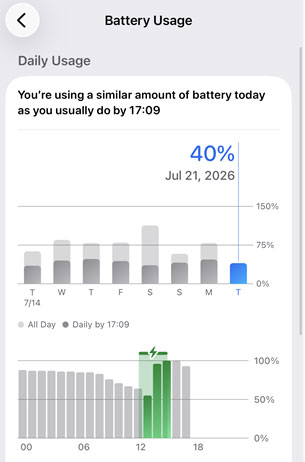
An app with unusually high background usage may need to be updated, restricted, or removed. Apple's Battery page may also display suggestions such as reducing brightness or enabling Auto-Lock.
2. Turn On Low Power Mode
Low Power Mode temporarily reduces background activity and certain visual effects. It can limit features such as Mail fetch, automatic downloads, Background App Refresh, display brightness, and the refresh rate on ProMotion displays.
On iPhone 15 and later:
- Step 1. Go to Settings > Battery.
- Step 2. Tap Power Mode.
- Step 3. Turn on Low Power Mode.
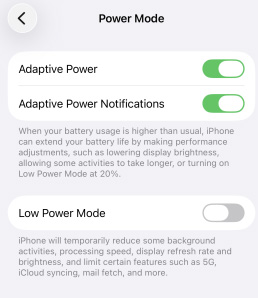
You can also add Low Power Mode to Control Center or ask Siri to enable it. It normally turns off automatically after the iPhone charges above 80 percent.
3. Enable Adaptive Power on Supported iPhones
Adaptive Power automatically makes small performance and background-activity adjustments when your daily usage is higher than usual. It can also enable Low Power Mode when the battery reaches 20 percent.
- Step 1. Open Settings > Battery.
- Step 2. Tap Power Mode.
- Step 3. Turn on Adaptive Power.
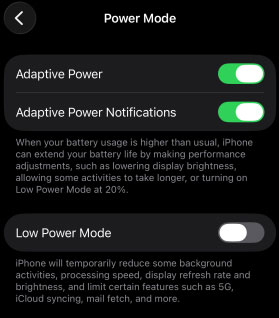
Adaptive Power requires iOS 26 or later and is supported on iPhone 15 Pro models, the iPhone 16 series, iPhone 17 models, and iPhone Air. It is enabled by default on iPhone 17 models and iPhone Air but may need to be turned on manually on some earlier supported models.
4. Use Auto-Brightness and a Shorter Auto-Lock Time
The display is often one of the largest sources of battery consumption. Keeping it unnecessarily bright or active for long periods can reduce battery life.
To enable Auto-Brightness:
- Step 1. Go to Settings > Accessibility.
- Step 2. Tap Display & Text Size.
- Step 3. Turn on Auto-Brightness.
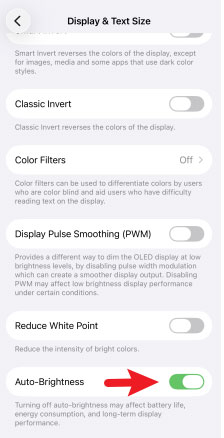
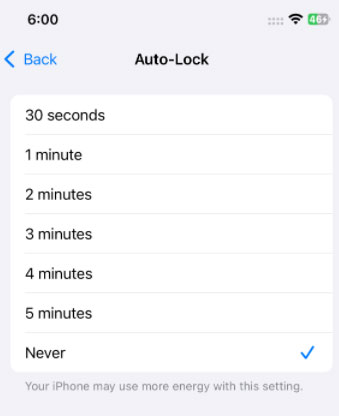
You can also open Settings > Display & Brightness > Auto-Lock and choose a shorter time, such as 30 seconds or one minute. Apple notes that high brightness and disabled Auto-Lock can increase power consumption.
5. Turn Off Always-On Display When You Do Not Need It
On supported iPhone models, Always-On Display keeps a dimmed version of the Lock Screen visible. Although iOS manages this feature efficiently, turning it off can help when maximum battery life is more important than quickly viewing information.
- Step 1. Open Settings > Display & Brightness.
- Step 2. Tap Always On Display.
- Step 3. Turn off Always On Display.
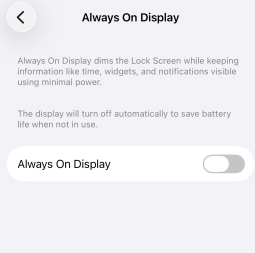
You can also leave it enabled but turn off Show Wallpaper or Show Notifications to simplify the Always-On screen.
6. Use Wi-Fi and Choose 5G Auto
A strong Wi-Fi connection is generally preferable when you are at home, at work, or in another trusted location. Constantly searching for a weak Wi-Fi or cellular signal can increase battery usage.
For compatible iPhones:
- Step 1. Go to Settings > Cellular > Cellular Data Options.
- Step 2. Tap Voice & Data.
- Step 3. Select 5G Auto instead of forcing 5G On.
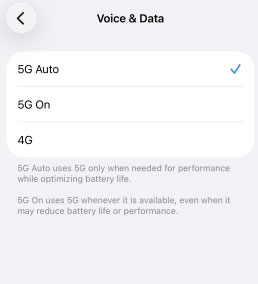
With 5G Auto, the iPhone can switch between 5G and LTE based on performance and battery needs. If you know you will be in an area with no service for an extended period, consider using Airplane Mode until coverage is available again.
 Note
Note
Wi-Fi Assist does not need to be enabled specifically to save battery. Its main purpose is to switch to cellular data when the current Wi-Fi connection is too weak.
7. Limit Background App Refresh
Background App Refresh allows suspended apps to check for new content. It is useful for some apps, but allowing every app to refresh can create unnecessary activity.
- Step 1. Open Settings > General.
- Step 2. Tap Background App Refresh.
- Step 3. Turn it off for apps that do not need to update before you open them.
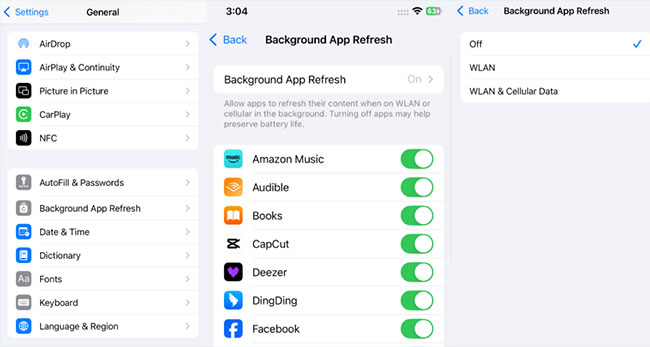
You can also set Background App Refresh to WLAN instead of WLAN & cellular data. Low Power Mode temporarily disables this feature automatically.
8. Review Location Services Permissions
Navigation, weather, fitness, delivery, and social apps may use your location. Instead of completely disabling Location Services, review which apps are allowed to access it.
- Step 1. Go to Settings > Privacy & Security > Location Services.
- Step 2. Select an app that does not need constant location access.
- Step 3. Choose While Using the App, Ask Next Time Or When I Share, or Never, depending on how you use it.

You can also turn off Precise Location for apps that only need an approximate area. Avoid restricting essential location access for Find My, emergency features, navigation, or apps that genuinely need continuous tracking.
9. Reduce Unnecessary Notifications
Notifications can wake the screen, play sounds, trigger vibrations, and encourage you to open apps more frequently. Limiting unimportant alerts can reduce interruptions and some unnecessary activity.
- Step 1. Open Settings > Apps.
- Step 2. Select an app and tap Notifications.
- Step 3. Turn off Allow Notifications, or disable sounds and Lock Screen alerts.

Keep alerts enabled for important apps such as Phone, Messages, banking, security, travel, and emergency services.
10. Update iOS and Check Battery Health
Software bugs or poorly optimized apps may sometimes cause abnormal battery drain. Install available iOS and app updates, especially when the problem affects many users.
After a major iOS update, the iPhone may temporarily perform background tasks such as indexing files, syncing data, and updating system resources. Apple recommends waiting a few days before judging battery performance after an update.
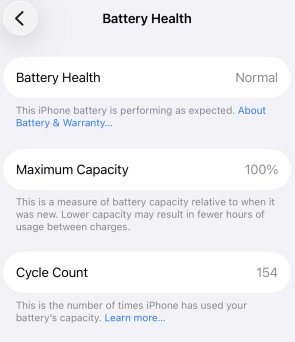
You should also check the physical condition of the battery:
- Step 1. Go to Settings > Battery.
- Step 2. Tap Battery Health.
- Step 3. Review Maximum Capacity and any service recommendations.
What If the iPhone Still Drains Battery Abnormally?
When battery drain begins after an iOS update and continues even after you update apps, restart the device, and review Battery Usage, the problem may be related to a deeper iOS software error.
In this situation, TunesKit iOS System Recovery offers another troubleshooting option. Its Standard Repair mode is designed to repair common iOS system problems without erasing user data. The software supports more than 150 iOS and iPadOS issues, including update failures, boot loops, frozen screens, and other system malfunctions.
Fix Abnormal iPhone Battery Drain with TunesKit
Repair iOS glitches that may cause excessive battery drain using Standard Repair without erasing your data.
 600,000+ Downloads
- Step 1. Install TunesKit iOS System Recovery on a Windows PC or Mac and connect the iPhone.
- Step 2. Choose iOS System Repair > Start > Standard Repair.
- Step 3. Download the matching firmware package and start the repair.

Conclusion
Use Low Power Mode, reduce screen brightness, limit background activity, and check Battery Health to extend iPhone battery life. If abnormal drain is caused by an iOS glitch, TunesKit iOS System Recovery can repair the system without data loss in Standard Repair mode.