


How Many Attempts to Unlock iPhone? Lockout Times Explained
How many wrong passcodes can you enter before your iPhone locks? Apple uses increasing security delays as failed passcode attempts add up, with recovery required after 10 or more counted attempts.
This guide explains how many iPhone passcode attempts you get, how long each lockout lasts, what happens after 10 failed attempts, and what to do next.

Quick Answer: How Many Failed Passcode Attempts Are Allowed?
Apple adds increasing security delays after repeated incorrect passcodes. According to Apple Platform Security, the 4th failed attempt triggers a 1-minute delay, followed by 5 minutes, 15 minutes, 1 hour, 3 hours, and 8 hours. At 10 or more failed attempts, normal passcode entry is no longer available and the iPhone requires recovery or reset.
| Failed Passcode Attempt | Security Delay | Detailed Guide |
|---|---|---|
| 1st–3rd | No delay | — |
| 4th | 1 minute | iPhone Try Again in 1 Minute |
| 5th | 5 minutes | — |
| 6th | 15 minutes | iPhone Try Again in 15 Minutes |
| 7th | 1 hour | iPhone Try Again in 1 Hour |
| 8th | 3 hours | iPhone Try Again in 3 Hours |
| 9th | 8 hours | iPhone Try Again in 8 Hours |
| 10th or more | Normal passcode entry unavailable; recovery required | See recovery options |
 Important Note
Do not keep guessing your passcode. More incorrect attempts lead to longer delays and can eventually require you to reset the iPhone.
 If your device already shows iPhone Unavailable, see our complete guide to fix iPhone Unavailable.
How Long Does iPhone Lock After Wrong Passcode Attempts?
iPhone uses increasing time delays to make repeated passcode guessing more difficult. These delays are enforced by the Secure Enclave, Apple's hardware-based security subsystem.
For example, after the fourth incorrect attempt, you must wait 1 minute before trying again. By the ninth failed attempt, the delay increases to 8 hours.
If your Lock Screen shows Try Again in X Minutes or Try Again in X Hours, wait until the displayed time ends before entering the correct passcode. Avoid random guesses.
You may see iPhone Unavailable or Security Lockout during the passcode lockout and recovery process. These are related lockout screens rather than fixed labels for a specific attempt number.
For more details about the second message, see our guide to Security Lockout on iPhone.
Does the Same Wrong Passcode Count Toward the 10-Attempt Erase Limit?
No. Apple states that consecutive entries of the same incorrect passcode do not count toward the 10-attempt Erase Data limit.
However, repeatedly trying passcodes is still not recommended. If you are unsure of the correct passcode, use the recovery options available on your Lock Screen instead.
What Happens After 10 Failed Passcode Attempts?
What happens after 10 consecutive incorrect passcodes depends partly on whether Erase Data was enabled before the lockout.
| Erase Data Setting | What Happens |
|---|---|
| Enabled | The iPhone automatically erases its content and settings after 10 consecutive incorrect passcodes. |
| Disabled | The iPhone does not automatically erase itself, but normal passcode attempts are no longer available and recovery is required. |
If Erase Data Is Enabled
After the 10th consecutive incorrect passcode, the iPhone erases its stored content and settings. You can then set up the device again. If you have an existing iCloud or computer backup, you can restore your backed-up data during setup.
If Erase Data Is Disabled
The iPhone does not automatically wipe itself after the 10th failed attempt.
However, this does not mean you can continue guessing indefinitely. Normal passcode entry becomes unavailable, and you must use an available recovery or reset method to regain access.
How to Enable or Check Erase Data Before a Lockout
You can only check this setting while you still have access to the iPhone.
- Step 1. Go to Settings > Face ID & Passcode, or Settings > Touch ID & Passcode.
- Step 2. Enter your current passcode, scroll down, and find Erase Data.
- Step 3. When enabled, this feature automatically erases the iPhone after 10 consecutive failed passcode attempts.
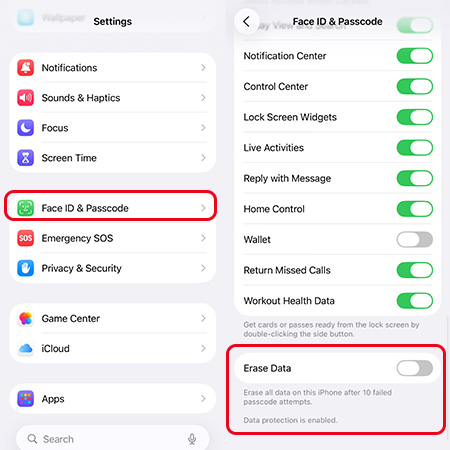
If your iPhone is already unavailable or locked out, you cannot enter Settings to check this option.
Note
On managed work or school devices, an administrator may set a lower failed-passcode limit.
What Should You Do After Too Many Failed Passcode Attempts?
The best next step depends on what appears on your Lock Screen. Do not keep testing random passcodes.
| Your Situation | What to Do |
|---|---|
| Countdown shown and you know the current passcode | Wait, then enter the correct passcode carefully |
| Changed the passcode within the last 72 hours | Try Previous Passcode |
| Forgot Passcode? or Erase iPhone appears | Use the Lock Screen recovery option |
| Find My was enabled | Erase the iPhone remotely with Find My |
| No usable on-device recovery option | Use Recovery Mode with Apple Devices or Finder |
| Prefer a guided computer-based process | Use TunesKit iPhone Unlocker |
Try Previous Passcode First If You Recently Changed It
On iOS 17 or later, Apple provides a 72-hour Passcode Reset period after you change your passcode. If you forget the new passcode but still remember the previous one, you may be able to regain access without erasing the iPhone.
This option requires:
- iOS 17 or later
- The passcode was changed within the last 72 hours
- Wi-Fi or cellular access
- An Apple Account signed in
- Find My enabled
- Forgot Passcode? available on the Lock Screen
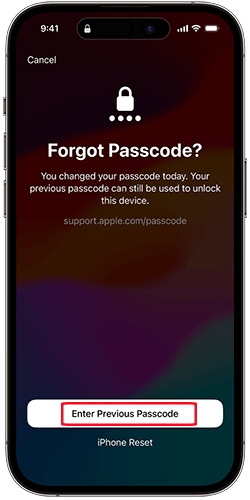
Start with Passcode Reset. If it isn't available, try an on-device reset, then use computer recovery if neither option works.
If You Have Forgotten the Passcode Completely
If Previous Passcode is unavailable, you may need to reset or restore the iPhone. Available options include:
- Resetting from Forgot Passcode? or Erase iPhone
- Using Find My
- Restoring through Apple Devices on Windows or Finder on Mac
- Using a computer-based screen-passcode removal tool such as TunesKit iPhone Unlocker
Try TunesKit iPhone Unlocker
If you can no longer enter the correct passcode and need a guided computer-based solution, TunesKit iPhone Unlocker can help remove the forgotten iPhone screen passcode. It guides you through device detection, firmware download, and screen-lock removal on Windows and Mac.
 600,000+ Downloads

Note
Resetting or removing a forgotten screen passcode normally erases the current data on the device. If Activation Lock appears afterward, the linked Apple Account may still be required.
For detailed steps, see our complete iPhone Unavailable recovery guide.
FAQs About iPhone Passcode Attempts
-
How many failed passcode attempts before an iPhone locks?
Apple starts adding security delays after repeated incorrect attempts. The 4th failed attempt triggers a 1-minute delay, and the delays increase with further attempts. At 10 or more failed attempts, normal passcode entry is no longer available.
-
Does iPhone erase itself after 10 failed attempts?
Only if Erase Data was enabled. If the setting is off, the iPhone does not automatically erase itself, but recovery is required after 10 failed passcode attempts.
-
Does restarting an iPhone reset failed passcode attempts?
No. Restarting does not clear the passcode lockout or failed-attempt state. If a security delay is already active, restarting also does not let you bypass it.
-
Can Face ID or Touch ID failures count as passcode attempts?
No. Failed Face ID or Touch ID attempts do not count as incorrect passcode entries. However, iPhone may require the passcode after repeated biometric failures.
-
Can I avoid losing data after too many passcode attempts?
Sometimes. If another passcode attempt becomes available and you know the correct passcode, wait and enter it carefully. If you changed your passcode within the last 72 hours on iOS 17 or later, Previous Passcode may also let you regain access without erasing the iPhone.
Conclusion
iPhone does not use a simple "10 tries and permanently locked" rule. Instead, Apple applies increasing security delays as incorrect passcode attempts continue. At 10 or more failed attempts, normal passcode entry is no longer available, and the device may also erase itself if Erase Data was enabled.
If you are already locked out, avoid further guesses. Wait for another passcode attempt when available, try Previous Passcode if eligible, or use the appropriate recovery option for your device.