


Top Solutions! How to Add Tidal Music to iMovie
Many creators struggle to drag their favorite Tidal tracks into iMovie projects, only to find the files won't budge. Even with a paid HiFi subscription and offline downloads, Tidal music often remains "greyed out" or completely invisible to the iMovie browser due to format restrictions.
Fortunately, this limitation can be bypassed. This guide explains why these compatibility issues occur and provides a proven, step-by-step solution to convert Tidal music into an iMovie-friendly format. Whether you are editing on a Mac or an iOS device, read on to learn how to successfully add Tidal music to iMovie.

Part 1. Why Can't I Add Tidal Music to iMovie Directly?
Before we fix the problem, it helps to understand why it exists. The issue isn't a glitch in iMovie; it is a deliberate feature of streaming services.
Understanding the Restrictions
Tidal, like Spotify and Apple Music, uses Digital Rights Management technology. When you "download" a song on the Tidal app, you aren't saving a standard audio file (like an MP3) to your hard drive. Instead, you are saving a cached, encrypted file that can only be unlocked and played within the Tidal application itself.
iMovie Supported Audio Formats
iMovie is a video editor, not a streaming player. To edit audio in iMovie, the file must have no restriction and in a specific format. iMovie supports the following standard audio formats:
- MP3 (MPEG-1 Audio Layer 3)
- WAV (Waveform Audio File Format)
- AIFF (Audio Interchange File Format)
- M4A (AAC - Advanced Audio Coding)
Since Tidal streams are encrypted, iMovie cannot read them. Therefore, the solution is simple: you need a "bridge" tool to decrypt the music and convert it into one of these supported formats.
Part 2. How to Save Tidal Audio Files
Some users who subscribe to the membership service on Tidal would ask why we cannot use Tidal music on iMovie. That's because all music from Tidal is saved in the virtual for protected by the digital right management, which prevents you from using Tidal music on any locations without the support of Tidal.
However, converting Tidal music to iMovie supported formats is a good method to achieve Tidal to iMovie. With the help of TunesKit Audio Capture, the downloading and conversion of Tidal music has ever been so easier. It empowers you to save Tidal music as iMovie supported formats like .MP3 and .WAV, then you can add Tidal music to your iMovie project.
Key Features of TunesKit Audio Capture
Record and download Tidal music in simple clicks. Record high-quality audio on Win/Mac from any source without losing any audio quality.
 600,000+ Downloads
Here we will tell you how to download and convert Tidal music to MP3 or other formats compatible with iMovie. Just perform the steps below to convert Tidal music to plain audio formats via TunesKit.
Step 1Add the Tidal app to TunesKit

After downloading and installing TunesKit Tidal Music Downloader to your computer, open TunesKit and check the interface of TunesKit. If you don't see the Tidal app listed on the program list, you need to add the Tidal app to TunesKit by drag-and-drop. Or you could click the "+" button to add it.
Step 2Adjust the output audio format

Then you need to configure the output audio parameters by clicking on the Format button. There are six audio formats including MP3, AAC, WAV, FLAC, M4A, and M4B, and you should pick the format of MP3 files among them and continue to configure the value of channel, bit rate, and sample rate for getting better audio quality.
Step 3Begin to convert Tidal to MP3

Once all the setting is done, you can click the Play button to launch the Tidal app from TunesKit and log into your Tidal account. Then choose to play a playlist or album from Tidal and TunesKit will record those music tracks from Tidal after several seconds. You can stop recording music from Tidal by clicking the Stop button.
Step 4Trim and cut Tidal music tracks

Now you could go to customize those recorded Tidal music tracks by clicking the Edit button at the rear of each track to open the service of audio customization. With the service, you could trim and merge all Tidal music tracks and edit the ID3 tags and other audio information. Then save all your edited music tracks to your computer.
Part 3. How to Import Tidal Music to iMovie on Mac
Once the conversion of Tidal music is completed, you could prepare to upload Tidal music into iMovie for use. In iMovie for Mac, you can drag audio files right into your timeline from the Finder. You can also use songs from your music library using the media browser within iMovie. Now, follow the two methods to add music to iMovie from Tidal on Mac.
Option 1. Drag Tidal music files into the iMovie project timeline

You can drag Tidal music files from the Finder and the Desktop right into the timeline of you iMovie project. Tidal music files dragged into the timeline behave differently depending on where you drag them.
Option 2. Add Tidal music using the iMovie browser to the iMovie project

1) You can browse and add Tidal music from your music library within iMovie. With your project open, click Audio at the top of the window, then choose to access your music library. Click Music in the Libraries list, then browse your downloaded Tidal music files.
2) To preview your Tidal music before you add it to the timeline, click the play button next to each song.
3) When you've found Tidal music track you like, drag it from the media browser to the timeline. Furthermore, you could edit Tidal music tracks in iMovie as you like.
Part 4. How to Import Tidal Music to iMovie on iPhone/iPad
This is where many users get stuck. Since you cannot easily convert files directly on an iPhone, you must transfer the converted files from your computer to your iOS device. The best modern method is using iCloud Drive or the Files App.
Phase 1. Transfer Music to iCloud Drive
Step 1. On your Mac or PC, locate the converted Tidal MP3/AIFF files.
Step 2. Upload these files to iCloud Drive.
- Mac: Drag files to the "iCloud Drive" folder in Finder.
- PC: Go to iCloud.com, log in, and upload the files to the drive.
Phase 2. Import from the Files App in iMovie iOS
Step 1. Unlock your iPhone or iPad and open the iMovie app.
Step 2. Open your project and tap the + (Add Media) button.
Step 3. Tap on Files (do not tap "Audio" -> "My Music", as that checks your iTunes library).
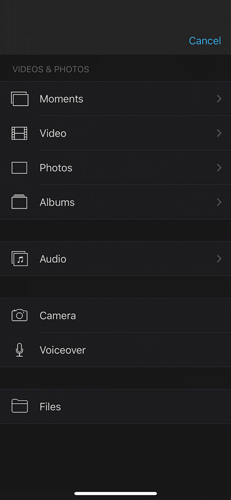
Step 4. Browse your iCloud Drive folders to find the Tidal song you uploaded.
Step 5. Tap the song. It will automatically drop onto your timeline.
Alternative: Using iTunes Sync
If you do not use iCloud, you can sync the files via the Apple Music app (formerly iTunes):
Step 1. Import the converted files into your Music/iTunes app on your computer.
Step 2. Connect your iPhone to the computer via USB.
Step 3. Sync your music library to your iPhone.
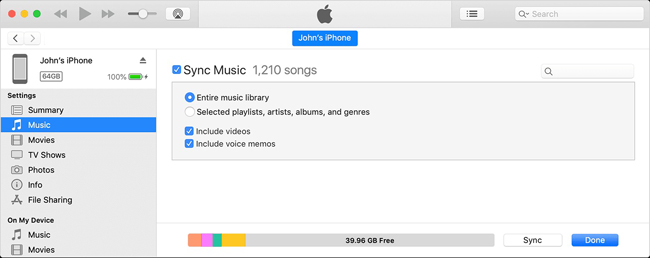
Step 4. Open iMovie on iPhone, tap +, go to Audio > My Music, and select the song from your library.
Part 5. FAQs About How to Add Tidal Music to iMovie
-
1. Is it legal to use Tidal music in iMovie?
It depends on how you use it. Converting Tidal music for personal use (like a home video or a private project) is generally considered acceptable. However, using copyrighted music in commercial videos or monetized YouTube content can lead to copyright strikes. Always consider using royalty-free music for commercial projects.
-
2. Can I use a screen recorder instead of a converter?
Yes, you can use software like Audacity or QuickTime to record the audio while it plays. However, this is time-consuming (you have to play the whole song), and the audio quality is usually lower than a direct conversion. It also records system sounds (like notification pings) if you aren't careful.
-
3. Why does my imported music have no sound?
This often happens if the file format is incompatible. Ensure you converted the Tidal track to MP3, WAV, or AIFF. If you used a weird format like FLAC or OGG, iMovie might not play it correctly.
Conclusion
While Tidal's high-fidelity audio is locked behind walls, it doesn't mean your creative projects have to suffer. By using a dedicated Tidal Music Converter like TunesKit Audio Capture, you can unlock your favorite tracks and transform them into iMovie-friendly files.
Whether you are editing on a MacBook Pro or cutting a quick clip on your iPhone, the key is simply changing the file format. Once you bridge that gap, you have the freedom to edit, fade, and mix your Tidal soundtrack exactly how you envisioned.


