


Can Custom IPSW Bypass iCloud Activation Lock? What You Need to Know

If you're searching for a way to bypass iCloud Activation Lock by modifying or creating a custom IPSW, you may find older tutorials claiming that editing an iPhone firmware file can remove the lock. But does this method still work on modern iPhones or iPad?
The short answer is no, not as a reliable or permanent Activation Lock removal method. we'll explain how custom IPSW bypass methods worked, why they are no longer reliable on modern iOS, and what options you can consider if your iPhone is stuck at the Activation Lock screen.
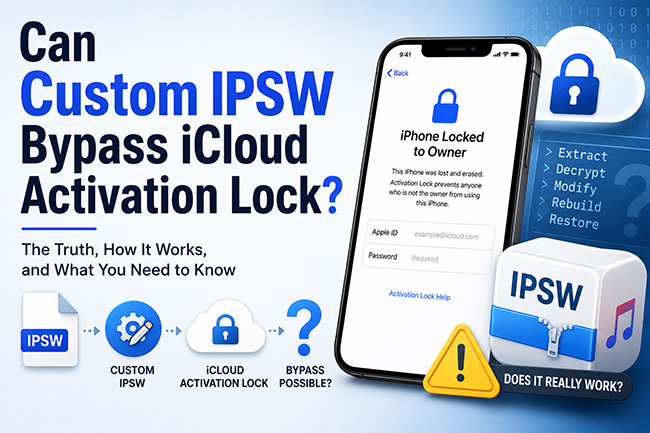
- Quick Answer: Can Custom IPSW Bypass iCloud Activation Lock?
- What Is a Custom IPSW?
- How Did Custom IPSW Activation Lock Bypass Methods Work?
- Can You Bypass iPhone Activation Lock by Editing an IPSW?
- Why Does Custom IPSW Bypass No Longer Work on Modern iOS?
Quick Answer: Can Custom IPSW Bypass iCloud Activation Lock?
Generally, no. Modifying an IPSW file does not directly remove the Activation Lock associated with an iPhone. Activation Lock is tied to Apple's activation system and the Apple Account linked to the device through Find My. Older techniques involving custom firmware or modified IPSW files may have worked in limited situations on certain legacy devices, but they are not a universal solution for modern iPhones.
If your iPhone displays "iPhone Locked to Owner" after a factory reset, changing or restoring the firmware will not normally remove the Activation Lock. The most reliable solutions are to use the linked Apple Account, ask the previous owner to remove the device, or contact Apple Support if you are the legitimate owner and have valid proof of purchase.
What Is a Custom IPSW?
An IPSW is the firmware package used by Apple devices during software updates and restores. When you update or restore an iPhone using Apple's official tools, the device uses a compatible IPSW file to install or reinstall iOS. A custom IPSW, on the other hand, refers to a modified firmware package that has been altered from the original Apple-provided software.
Historically, custom IPSW files were associated with jailbreaking and other modifications on certain older Apple devices. Depending on the device and iOS version, users could modify parts of the firmware before restoring it to the device. This led to the idea that a modified IPSW could also be used to bypass iCloud Activation Lock.
However, these concepts should not be confused. Modifying an IPSW is not the same as removing Activation Lock. An IPSW controls the software installed on the device, while Activation Lock is connected to the device's activation process and the Apple Account associated with Find My. This distinction is important when evaluating claims that a custom IPSW can permanently unlock an iPhone.

How Did Custom IPSW Activation Lock Bypass Methods Work?
Older custom IPSW bypass methods generally relied on modifying specific components of an iOS firmware package before restoring it to an iPhone. The basic concept was to:
- Obtain the appropriate IPSW firmware file.
- Extract or unpack the firmware package.
- Modify certain system components.
- Rebuild the modified firmware.
- Attempt to restore the iPhone using the customized IPSW.
Some older guides claimed that removing or changing specific system components could interfere with the normal setup or activation process. However, this approach had significant limitations.
It did not necessarily remove the device's association with the original Apple Account. In many cases, it only attempted to alter how the device behaved locally during setup. This means that even if a modified firmware appeared to bypass part of the setup process, it did not necessarily provide a fully activated iPhone with all normal features.
For example, users could still encounter limitations involving:
- Cellular connectivity
- Phone calls
- Mobile data
- iCloud services
- Apple Account sign-in
- App Store access
- iMessage and FaceTime
- Device activation after a restart
As a result, a custom IPSW workaround should not be considered equivalent to permanently removing Activation Lock.
Can You Bypass iPhone Activation Lock by Editing an IPSW?
If you're specifically wondering whether you can bypass iPhone Activation Lock by editing an IPSW, the answer depends heavily on the device, iOS version, and the security vulnerabilities available at the time.
For modern iPhones, editing an IPSW alone is not a reliable way to remove Activation Lock. The main reason is that Activation Lock is not simply a local software setting stored inside the IPSW. The device's activation status involves Apple's activation infrastructure and the Apple Account associated with the device.
Therefore, modifying the firmware does not automatically change the device's ownership or Activation Lock status on Apple's servers. This is also why restoring an iPhone with a standard IPSW does not normally remove Activation Lock. After the restore is complete, the device may still require activation before it can be used normally.
What Happens After Restoring a Locked iPhone?
If an iPhone is still linked to another person's Apple Account, restoring the device may simply erase its local data while leaving the Activation Lock status unchanged.
After the restore, the user may see iPhone Locked to Owner or an Activation Lock screen asking for the Apple Account credentials previously associated with the device. This is why repeatedly restoring or resetting a locked iPhone is unlikely to solve the problem. The firmware may be completely reinstalled, but the Activation Lock association remains.
Why Does Custom IPSW Bypass No Longer Work on Modern iOS?
There are several reasons older firmware-based techniques have become increasingly unreliable.
1. Activation Lock Is Not Just a Local iOS Setting
One of the biggest misconceptions is that Activation Lock can be removed simply by changing files inside the firmware. In reality, Activation Lock is connected to Apple's activation process and the device's relationship with the Apple Account that enabled Find My. Changing local system files does not automatically remove that server-side association.
2. Modern iOS Uses Stronger Security Protections
Apple has continued to strengthen the security architecture of its devices and operating systems. Modern iPhones use multiple layers of hardware and software security, making old firmware modification techniques much less effective than they were on some legacy devices. A method that worked on an older iPhone may therefore be completely ineffective on a newer model or iOS version.
3. Apple Firmware Is Digitally Signed
Apple uses firmware signing mechanisms to control which software versions can be installed on its devices. This creates additional restrictions for anyone attempting to install modified firmware. Even if you successfully modify an IPSW file, that does not mean the iPhone will accept and fully activate the modified firmware.
4. Activation and Firmware Are Two Different Things
This is perhaps the most important point. A custom IPSW changes the firmware installation process. Activation Lock controls whether the device can be activated and associated with a new user. These are separate mechanisms. Therefore, Custom firmware modification does not automatically equal Activation Lock removal.
Custom IPSW vs. Activation Lock Removal
The following comparison helps explain why modifying firmware is not the same as removing an Activation Lock.
| Feature | Custom IPSW Modification | Activation Lock Removal |
|---|---|---|
| Modifies iOS firmware | Yes | Not necessarily |
| Erases device data | May | Usually during device reset |
| Changes Apple Account association | No | Yes, when properly removed |
| Removes "iPhone Locked to Owner" | Not reliably | Yes, when successfully removed |
| Requires Apple's activation process | Yes | Yes |
| Provides permanent activation | Not guaranteed | Yes, when officially completed |
| Works universally on modern iPhones | No | Depends on ownership and account status |
The key takeaway is that a modified IPSW may change the software installed on an iPhone, but it does not automatically remove the Activation Lock tied to the device.
What Can You Do If Custom IPSW Doesn't Work?
If you've learned that modifying a custom IPSW is not a reliable way to bypass Activation Lock, you may be wondering what options are still available. The answer depends on whether you are the legitimate owner of the device and whether you can access the Apple Account previously associated with it.
In many situations, official solutions remain the safest and most reliable approach. If those options are unavailable, some users may consider compatible third-party tools designed for Activation Lock-related situations.
| Situation | Recommended Solution |
|---|---|
| Device still linked to previous owner | Ask the owner to remove the device |
| Forgot Apple Account credentials | Recover the Apple Account |
| Have valid proof of ownership | Contact Apple Support |
| Official options unavailable | Consider a compatible third-party tool |
Method 1. Ask the Previous Owner to Remove Activation Lock
If you purchased the iPhone from another person and it is still linked to their Apple Account, the easiest solution is to contact the previous owner. They can remove the device remotely through Apple's Find My service without needing physical access to the iPhone. The previous owner can:
- Step 1. Sign in to their Apple Account in the iCloud.com website.
- Step 2. Open the Find My section.
- Step 3. Select the locked iPhone from All Devices.
- Step 4. Choose Remove.
- Step 5. Confirm the removal.
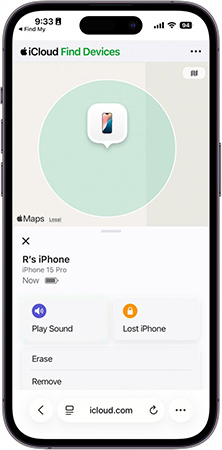
Once the device has been removed from the account, restart the iPhone and complete the setup process again. This is often the fastest and most reliable way to remove Activation Lock from a second-hand device.
 View Also:
 Method 2. Recover the Apple Account Linked to the Device
If the iPhone belongs to you but you cannot remember the Apple Account password, recovering the account may solve the problem. Common situations include:
- Forgotten Apple Account password
- Lost access to a trusted phone number
- Lost access to a trusted device
- Inactive account used years ago
In these cases, Apple's account recovery process may help restore access to the account associated with the device. Once you successfully sign in with the correct credentials, Activation Lock can usually be removed normally during setup.
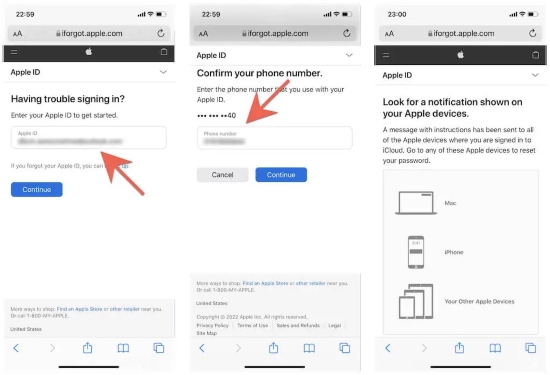
Method 3. Contact Apple Support
If you are the legitimate owner of the iPhone and can provide valid proof of ownership, Apple Support may be able to assist. Examples of acceptable ownership documentation may include:
- Original purchase receipt
- Carrier purchase record
- Authorized reseller invoice
- Other ownership documents accepted by Apple
Apple reviews requests individually, and approval is not guaranteed. However, if you legitimately own the device, contacting Apple Support is often the most appropriate official solution.
Method 4. Use a Compatible Activation Lock Removal Tool
In situations where official methods are unavailable, some users explore third-party Activation Lock removal tools. These tools are designed to help users regain access to supported devices under specific conditions. One example is TunesKit iPhone Unlocker.

Unlike custom IPSW modification methods that require manually extracting firmware packages and altering system files, TunesKit focuses on providing a more streamlined process for supported devices. Potential advantages include:
- No manual IPSW editing
- No firmware unpacking or rebuilding
- User-friendly interface
- Guided unlocking workflow
- Support for various iPhone and iPad models
Before using any third-party solution, always review the latest supported device list, iOS compatibility information, and usage requirements. Because Apple continuously updates its security mechanisms, compatibility can vary between device generations and software versions.
Key Features of TunesKit iPhone Unlocker
With this software, you can unlock your device and use it normally, no need to contact the previous owner.
 600,000+ Downloads
Modern iOS vs. Older iOS: Why the Difference Matters
Many Activation Lock bypass discussions online reference techniques that were developed years ago. However, there is a significant difference between older Apple devices and modern iPhones.
| Aspect | Older iOS Devices | Modern iPhones |
|---|---|---|
| Custom IPSW modification | Possible in limited scenarios | Highly restricted |
| Firmware customization | More common historically | Strongly limited |
| Activation Lock bypass success | Situational | Generally unreliable |
| Security protections | Less advanced | Significantly stronger |
| Permanent Activation Lock removal | Not guaranteed | Requires proper account removal |
| Recommended approach | Device-specific | Official account removal or compatible solutions |
This is one of the main reasons many custom IPSW tutorials no longer deliver the results users expect today. Methods discussed in older guides often target devices, exploits, or iOS versions that are no longer relevant to current iPhone models.
FAQs About Custom IPSW and Activation Lock
-
Does Restoring an IPSW Remove iCloud Activation Lock?
No. Restoring an iPhone with an official IPSW reinstalls iOS but does not remove the Activation Lock associated with the device. If the iPhone remains linked to an Apple Account through Find My, the Activation Lock screen may still appear after the restore process is complete.
-
Is There an IPSW Without Activation Lock?
No official IPSW exists that automatically removes Activation Lock. Activation Lock is managed separately from the firmware package itself. Any website claiming to offer a universal IPSW that permanently removes Activation Lock should be approached cautiously.
-
Can I Use a Custom IPSW on Any iPhone?
No. Firmware compatibility depends on the specific iPhone model and iOS version. Additionally, Apple only allows installation of firmware versions that are currently signed and supported. This means a custom IPSW created for one device or software version may not work on another.
Final Verdict
Custom IPSW methods may have worked on some older devices, but they are not a reliable way to remove iCloud Activation Lock on modern iPhones. When you are locked of your iPhone by an Activation Lock, you can use the reliable solutions shown in this article like ask previous owner for help, and consider TunesKit iPhone Unlocker, which allows users to remove Activation Lock without password.